Christmas Bird Count in Fayette County, WV
Community science and bird watching. Yes, please!
The Christmas Bird Count (CBC) is a program of the National Audubon Society since 1900, in which thousands of volunteers across the U.S., Canada, and many countries in the Western Hemisphere spend a day counting birds within their local geographic circle. All skill levels are encouraged to participate. CBC history and answers to frequently asked questions can be found at audubon.org.
Participation is Free.
Sign up is Required. Send your name, email address and phone number to the circle compiler,
Spend as time as you want to. December 19th, identify the species of birds you see and hear, count the number of each, and track your mileage and time.
Easy-peasy. Complete printed data collection form(s) then enter your data to the online form.
Loop In with the Facebook Page.
Date: December 19, 2026 Count Year: 127 Circle Name: WVOH (Oak Hill, Fayette County, WV)
Covering a 7.5 mile radius from the intersection of Lochgelly Rd, Summerlee Rd, and Byrnside St in Oak Hill, covering territory between Beckwith to Mount Hope, and Mossy to Cunard.
WVOH Circle Compiler: Rachel Davis
Data Collection: take a couple of printed forms to note your data. At the end of your count, enter your completed data into the Online Data Entry Form. The online form is the preferred method of submitting your collected data. For those without internet access, completed printed Data Collection Forms may be scanned or photographed and returned by email or text to Rachel within 24 hours.
How Do Counts Work?
Circle Map & Routes
Sign Up to Participate
Participant Guide to Data Collection
Data Collection Forms
Print Car Sign pdf
Rare Bird Report
Audubon CBC Live
Previous WVOH Count Results
WV Audubon CBC Archives
CBC Species Trends Map *NEW
How Do Counts Work? (from audubon.org)
There is a specific methodology to the CBC, so all participants must make arrangements to participate in advance with the circle compiler. The CBC is open to everyone!
Each count takes place in an established 15-mile diameter circle, and is organized by a count compiler. Count volunteers follow specified routes through a designated 15-mile (24-km) diameter circle, counting every bird they see or hear all day. Not just a species tally—all birds are counted all day, giving an indication of the total number of birds in the circle that day.
Birders of all skill sets are involved in the CBC.
If your home is within the boundaries of a CBC circle, then you can stay at home and report the birds that visit your feeder on count day as long as you have made prior arrangement with the count compiler.
Find more Answers to your top questions about the Christmas Bird Count on audubon.org. 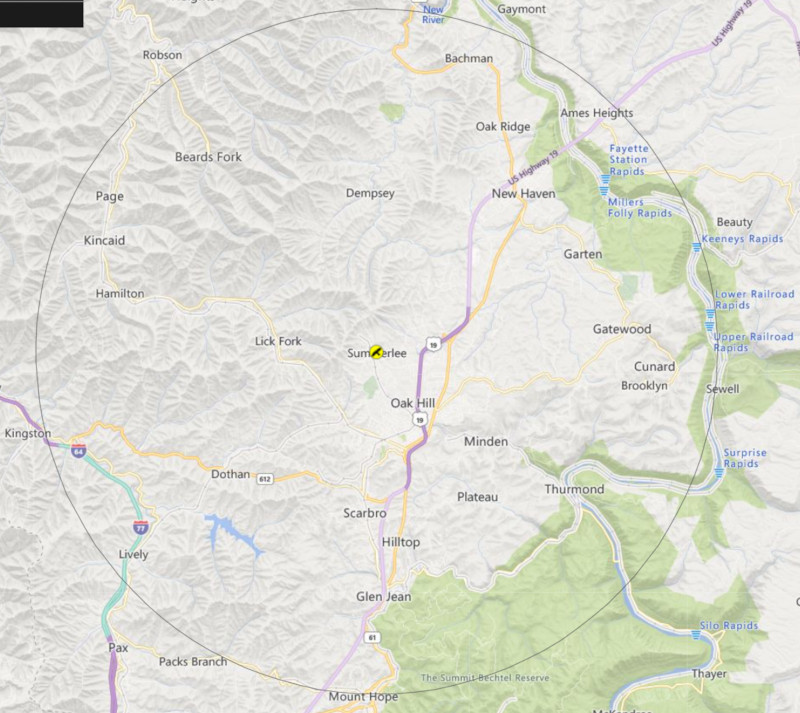
Circle Map
WVOH Circle Map on audubon.org, and all other circles. The newer version of the map requires you to search for CBC Circles: WVOH. The WVOH Circle covers a 15 mile diameter that includes territory between Beckwith to Mount Hope, and Mossy to Cunard.
Participants & Routes WVOH cy 126 *updated 12/20/2025
Brown: the Summit
Corley: yard feeder
Davis +2: Minden Rd, Concho, River Beach, ACE to Gatewood
Godfrey +1: Fayetteville Cemetery, Arrowhead, Long Point to Kaymoor Top
Hall: yard feeder
Heeter: the Summit
Hermanns +3: Oak Hill Rail Trail AND Downtown Fayetteville to Oak Hill
Lindsey +2: Dun Glen Boat Launch to Stone Cliff Campground
Lynch: Plumb Orchard Lake
Reynolds: the Summit
Rubianto: Peregrine to Endless; Burnwood Rim to Rim
Shaw +1: Sanger to Rend Trailhead
Tatum: Mossy
Vuranch & Worthington: yard feeder
Available Routes/Destinations *Google maps provided
Fayette County Park (~1 mi)
Fayette County Park to Cotton Hill (~5 mi)
Equestrian Adventures to Old Cunard Landfill (~3.6 mi)
Kincaid (~1 mi)
Mount Hope (~1 mi)
Page (~1 mi)
Ruby Welcome Center (~1 mi)
Wolf Creek Park (~1 mi)
Wolf Creek, Pleasant View, Gatewood loop (~14 mi)
*Routes greater than ~1 mi require driving.
Yard Feeder(s) -provide me with the address.
Sign Up to Participate
Participation is free, but you must sign up in advance. Contact the Circle Compiler
Participants’ Guide to Data Collection (from audubon.org)
Talk with your circle compiler in advance of the count day for guidance on survey areas and routes.
Record every bird seen or heard in your assigned area, between midnight and 11:59 pm on the count date.
Try to cover your route/destination thoroughly.
Record all hours spent watching or listening for birds, with all of your start and stop times.
Record all miles traveled one-way while watching or listening for birds (don't count backtracking; see guide to CBC party miles/hours for details).
Record each mode of transportation (by foot, by car, etc.), and match the mode with hours and miles for each type.
Record hours watching at feeders separately from birding in the field and separately from nocturnal/owling (three separate forms).
Give your completed WVOH CBC Data Collection Form to your Circle Compiler within 24 hours of the count day.
Field Observers (excludes Feeder observers and Nocturnal/Owling observers)
Birds tallied by observers in the Field during daylight hours are counted separately from Feeder observers, and separately from Nocturnal/Owling observers. While in the Field, if you happen by a feeder, those birds are counted in the Field.
Round hours to the nearest quarter-hour, and distances to the nearest quarter-mile or quarter-kilometer. Note all start and stop times. If you stop counting longer than 15 minutes, a stop time is noted, then a new start time is noted when counting resumes.
Two (2) or more individuals observing together make a "party."
Distance by Foot is the effort of the party, not a sum of the individuals. For example: 3 individuals walking together 1 mile is 1 mile for the party; if the party splits and 2 individuals walk 1 mile in one direction and 1 individual walks 1 mile in another direction, the party walked 2 miles.
A route re-traced or back-tracked is recorded as the one-way distance. Deduct back-tracking mileage (not the hours). For example: An individual or party walks 1 mile out a path then returns the same way, the distance is recorded as 1 mile.
Hours by Foot records the entire time spent on the path, not just the one-way distance.
If appropriate, enter a 0 for distance. For example: A stationary individual or party observing a roost, lake, or river bank may spend 1/2 hour in one spot resulting in 1/2 hour and 0 miles.
Indicate each mode of transportation used on your Report (foot, car, bicycle, atv, boat) and match the mode with hours and miles for each type.
Counting when re-tracing your route - If an individual or party needs to retrace their path along their route, birds should not be recounted. However, if other species or new individuals of the same species are encountered, they should be counted. For example: A party walks out a trail and counts 10 robins, later while retracing their steps back they count 15 robins and a crow, they would record 15 robins and 1 crow.
Use: Field and Nocturnal/Owling Data Collection Form.
Feeder Observers (excludes Field observers and Nocturnal/Owling observers)
Round Feeder observation hours to the nearest quarter-hour. Feeder observation hours is the time a feeder was observed, not a sum of time for all individuals watching a feeder at the same time. For example: 2 people watching one feeder, 1 person watches from 8:00 - 9:00 and the other watches from 8:30 - 10:00, the total observation time for that feeder is two hours. If those 2 people watch two separate feeders, the time is added together for a total of two and a half hours.
Record the maximum number of each species visible or within earshot at one time (don't continue to add chickadees for your entire watch period).
When a Field observer happens by a yard feeder, those birds are counted in the Field - it's important for Feeder Observers to contact the Compiler with their address in advance, so those birds aren't counted twice.
Use: Feeder Data Collection Form.
Nocturnal/Owling Observers (excludes Field observers and Feeder observers)
Birds tallied by observers during non-daylight hours.
Round hours to the nearest quarter-hour, and distances to the nearest quarter-mile or quarter-kilometer.
Two (2) or more individuals observing together make a "party."
Distance by Foot is the effort of the party, not a sum of the individuals. For example: 3 individuals walking together 1 mile is 1 mile for the party; if the party splits and 2 individuals walk 1 mile in one direction and 1 individual walks 1 mile in another direction, the party walked 2 miles.
A route re-traced or back-tracked on foot is recorded as the one-way distance. For example: An individual or party walks 1 mile out a path then returns the same way, the distance is recorded as 1 mile.
Hours by Foot records the entire time spent on the path, not just the one-way distance.
If appropriate, enter a 0 for distance. For example: A stationary individual or party observing a roost, lake, or river bank may spend 1/2 hour in one spot resulting in 1/2 hour and 0 miles.
Indicate each mode of transportation used on your Report (foot, car, bicycle, atv, boat) and match the mode with hours and miles for each type.
Go to: Field and Nocturnal/Owling Data Collection Form.
WVOH CBC Data Collection Forms
Take a couple of printed forms to note your data, then at the end of your count, enter your completed data into the Online Data Entry Form. The online form is the preferred method of submitting your collected data. Completed printed Data Collection Forms may be scanned or photographed and returned by email or text to Rachel within 24 hours.
Print a Field and Nocturnal/Owling Data Collection Form.
Print a Feeder Data Collection Form.
Online Data Entry Form. *PREFERRED* As a fellow CBC volunteer, I understand time is valuable. By completing this digital form, you'll save me multiple hours of manual data copying and entry. Additionally, a copy of your submitted form data is sent to the email address you provide as Observer.
Avid eBirders may share Trip Report tallies with me - send one link to me containing your party’s totals and effort data - here's how.
WV Audubon CBC Archives, provided by the Brooks Bird Club in Wheeling, WV.
Things to Note
• Bald Eagles - age the eagle to your best ability, as Sub-Adult or Adult. Aging eagles is helpful in avoiding recounting birds that move distances within our circle.
• When possible, note the age (Adult or Sub-adult) of all raptors. This isn't required, but is very helpful.
• Species like Northern Harriers that cover large areas while hunting but roost together - count carefully, not to double count.
• Estimate Crow and Vulture roosts. Note on your form that you located a roost. Do your best to estimate and round down. It's better not to overestimate. Get more than one person's opinion, if possible. Don't add field and roost results together unless you're confident you're not double counting.
• Estimating any species - round down the total, note that it is an estimate, and be conservative with your numbers.
Merlin Sound ID Guidelines (from NAS CBC)
Inclusion Permitted IF:
• an unfamiliar vocalization is heard by CBC participants and Merlin is used to assist in the identification.
• Merlin picks up a vocalization that participants did not hear right away, but then they do hear it and identify it.
Visual Confirmation Required, Inclusion Permitted:
• If Merlin assists in the identification of the call of a rare or hard-to-identify species.
• As with by-ear identification, species that are often imitated by others (hawks by jays, mimicry by mimics, etc.).
NOT Permitted:
• If Merlin identifies a vocalization of a species that is neither heard nor visually confirmed, that species may not be included in the CBC results.
Rare Bird Report
Try to get a picture, or as many details as possible: plumage, shape, size, vocalizations, habitat, behavior, etc., and be prepared to provide additional information such as optics used for viewing, your distance from the bird, and viewing conditions; photos, video, or sound recordings.
Birds that require a Rare Bird Report (RBR):
Geese other than Canada
Shorebirds other than Killdeer and Wilson's Snipe
Wading birds other than Great Blue Heron and Double-crested Cormorant
Warblers other than Yellow-rumped
All Golden Eagles
Print, complete and return to Rachel immediately: Rare Bird Report form, pdf.
Audubon LIVE
See what other people around the hemisphere are doing/seeing on their Christmas Bird Counts and add your own count day photos on the Audubon's CBC LIVE interactive map.
CY 126 Overview of Results:
The annual Oak Hill Christmas Bird Count (WVOH CBC) for the National Audubon Society was held Saturday, December 20, 2025. Sixteen volunteers took to the roads and trails, and five monitored their yard feeders for a combined total of 43.75 hours and 117.15 miles of birding. The volunteers observed 64 species and tallied 1746 individual birds.
The American Crow took the top spot for abundance this year with 333 individuals, though that wasn't a high record for the species. Other consistently abundant species included the American Goldfinch at 149, and Dark-eyed Junco at 124.
Record-breaking tallies came from two species with "Common" in their name, but they proved to be anything but ordinary during the 47th year of the WVOH CBC: the Common Merganser with 5 individuals counted, and the Common Raven with 30 individuals counted. In the count's 47-year history, the Common Merganser had been observed only four times, and the Common Raven more than doubled its previous high record. Interestingly, a spectacular sight for anyone, this Common Raven count included an early morning flock of 21 flying in a wingtip-to-wingtip, single-line formation. Ravens sometimes fly with wingtips touching during aerial bonding behaviors and are known to congregate to roost.
An unexpected data point was the absence of Mallards. Since 1990, the WVOH CBC had recorded between 5 and 92 Mallards annually. This year marked the first time since 1989 that this species was missing from the report.
See WVOH summary of 126th CBC pdf.
CY 125 Overview of Results:
20 field participants. 5 feeder participants. 12 field reports. 5 feeder reports. 0 nocturnal reports. 2084 total birds. 57 species. 92 total participant miles. 48 field hours. 9 feeder hours.
The Oak Hill Christmas Bird Count, held December 14, 2024, counted 2084 birds of 57 species. The total species is slightly above average in the circle's forty-five-year history.
There's so much more territory to cover, especially in the west-north-west quarter of the circle, I'm hopeful more folks will enjoy it with us next year.
The circle counted its first CBC record for two (2) species: American Redstart and Ovenbird. Both species were observed by three people at the Plumb Orchard Lake area.
Other high-count record breakers in the Oak Hill circle include:
326 Dark-eyed Juncos make highest on record (and the highest count of any species in this count), 12 Common Ravens, 19 Winter Wrens, 9 Red-headed Woodpeckers.
Additionally, 4 Bald Eagles and 1 Common Merganser were observed and have only been observed in three previous counts.
See WVOH summary of the 125th CBC.
See the Audubon summary of the 125th CBC.
CY 124 Overview of Results:
29 participants 2212 total birds 54 species 5 feeder reports 13 field reports 0 nocturnal reports 189.75 total participant miles 67.75 total participant hours
"The Oak Hill Christmas Bird Count, held on December 16th with 29 participants, covered nearly 190 miles and counted 2,212 birds of 54 species. The total species is slightly above average in the circle's forty-four-year history, and the total of participants is a new high record! A few of you joined others on their respective routes, a few elected to take routes and destinations on your own, and others counted from home!
There's so much more territory to cover, especially in the west-north-west quarter of the circle, I'm hopeful more folks will enjoy it with us next year on a route, to a destination, or from the comfort of home. Send new folks this way, any time of year. I'll contact them next fall when I reach out to you all again. Tentatively, our next CBC count day will be the first Saturday of the count season, December 14, 2024. We'll hold the warm soup social again, too!
The most uncommon species of this count, recorded on only two previous counts, was the Common Merganser: Daniel Rubianto observed 4 on the New River at Stone Cliff campground. Red-tailed Hawks pushed their previous high count up one more digit, to 10. The number of Turkey Vultures and Common Ravens tied with their previous high counts of 29 and 10, respectively." - Rachel Davis
WV Audubon CBC Archives
WV Audubon CBC Archives provided by the Brooks Bird Club in Wheeling, WV.


